by Nicholas Schofield
Catholic presbyteries are normally purpose-built for the church and have few former residents who were not involved in church ministry. The presbytery at 1 Osborn Road, Uxbridge is an exception. Built in 1903, it only became the priest’s residence in 1915. Prior to that, it was the home of the Osborn family, who were staunch Congregationalists and involved in the development of this residential area, giving their name to the road. Up until the 1960s, the Catholic church was surrounded by housing and what is now ‘1 Osborn Road’ was ‘37 Lawn Road’. Initially, the house bore the name ‘Holtfleet’ (Holtfleet is a village in Worcestershire, with a famous bridge over the Severn designed by Thomas Telford).
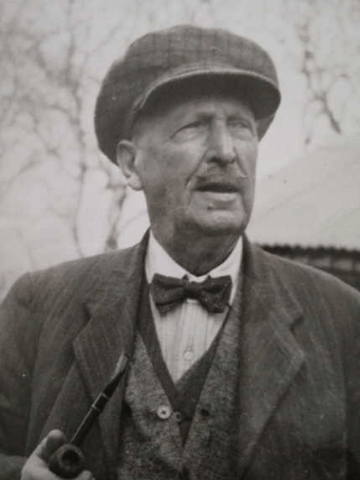
Jabez Osborn (1850-1936) – an unusual name, presumably named after the character in 1 Chronicles – was originally from Kelvedon (Essex). He set up a successful painting, decorating, plumbing and signwriting business, based at 77-78 Montague Road, Uxbridge. Losing this premises when the Metropolitan Railway extended to the town, they moved to a new house in Lawn Road. Next to the house was the business headquarters.
Jabez’s obituary in 1936 stated that he was one of Uxbridge’s ‘best known townsmen’ – a familiar figure not only as a local businessman but as a member of the Urban Council and the Board of Guardians, which administered local poor relief. He is described as always ‘cheery and optimistic’ and followed the quaint old Essex custom of calling everybody ‘neighbour’ – a name which he also came to be known as himself. He was a keen sportsman, an excellent shot and one of the early devotees of diabolo.
Of his children, Jabez Junior (1880-1954) and Wilfrid (b.1881) continued his business after his retirement. The former was also a talented musician, a member of the Providence Drum and Fife Band and Providence Orchestral Society (at the Congregational church), and for thirteen years bandmaster of the Uxbridge and Hillingdon Band.
His youngest son, Herbert Ewart (1885-1943), had a desire from an early age to be a missionary. After acquiring the necessary medical skills working in the dispensing department of Savory & Moore, the famous London pharmacy, he left for Nyasaland (modern day Malwai) in January 1906 as part of the Zambesi Industrial Mission. Founded by Joseph Booth in 1892, it combined Christian formation with practical training so that locals could become self-sufficient. Settling for many years at Mihecani (in what is now Mozambique), the chief products of the mission were coffee, cotton, rubber and chillies.
During the First World War, Herbert joined the Nyasaland Field Force and was commissioned as lieutenant on 1 November 1917. He also served for a time as an orderly in the French Red Cross. This military tradition continued in one of his sons, Herbert Junior, who was awarded a Distinguished Flying Cross for conducting a belly landing with his badly damaged plane after a raid during the Second World War.
On 31 January 1914 Jabez’s wife, Sarah, died after a long illness and was buried at Uxbridge Cemetery. The following year he retired from the business and returned to Kelvedon. 37 Lawn Road was sold to the Catholic Church – an ideal presbytery since the temporary Catholic chapel was nearby. The Osborn family, though not Catholic, were on friendly terms with the clergy: Jabez used the Young Men’s Literary Institute, where he could often be found playing billiards with Fr John Brady (area dean and also a councillor). The priest is also listed as attending Sarah’s burial, even though it was conducted by a Congregationalist minister.
 Uxbridge LOCAL History Society